

Flooring isn't something you only look at. You walk across it first thing in the morning. Kids sit and play on it. You stand on it while making dinner. Your pets stretch out on it. So while color and style matter, there's another question worth asking: How does the flooring actually feel underfoot?
That's one reason luxury vinyl flooring has become such a popular choice. Along with realistic wood and stone visuals, easy maintenance, and strong everyday performance, many luxury vinyl products provide a comfortable surface for daily living.
Gerami's Floors has served Lafayette, LA, since 1920. As a family-owned flooring company, Gerami's works with homeowners, builders, remodelers, and commercial clients to find flooring suited to different spaces and budgets. If you're considering LVT flooring or LVP flooring, comfort deserves a place alongside appearance, durability, and price on your checklist.
Is luxury vinyl flooring comfortable to walk on?
Generally, yes. Many homeowners find luxury vinyl comfortable underfoot, especially compared with harder materials such as ceramic tile or natural stone.
Part of that comes down to construction. Luxury vinyl has some resilience, meaning it doesn't usually feel as hard and unforgiving as stone or ceramic. Depending on the product, its core and attached underlayment can also influence the finished feel.
That difference may seem small when you take a few steps across a flooring sample. Live with the floor all day, though, and comfort becomes more noticeable.
Think about the places where you spend time standing. Kitchens are a perfect example. Preparing meals, cleaning, and doing dishes can mean spending long stretches on your feet. A floor with a slightly more forgiving feel may be appealing.
Comfort varies by product, so don't assume every luxury vinyl floor feels identical. Construction, thickness, core type, underlayment, subfloor, and installation method all contribute to the final result.
Why does luxury vinyl feel different from tile or hardwood?
Every flooring material responds differently underfoot.
Ceramic and porcelain tile are hard surfaces. That's part of what gives them their durability, but it also means there isn't much give when you walk or stand on them.
Hardwood has a natural warmth and distinctive feel. Luxury vinyl plank flooring takes a different approach. It can reproduce hardwood's visual character while offering its own combination of resilience and comfort.
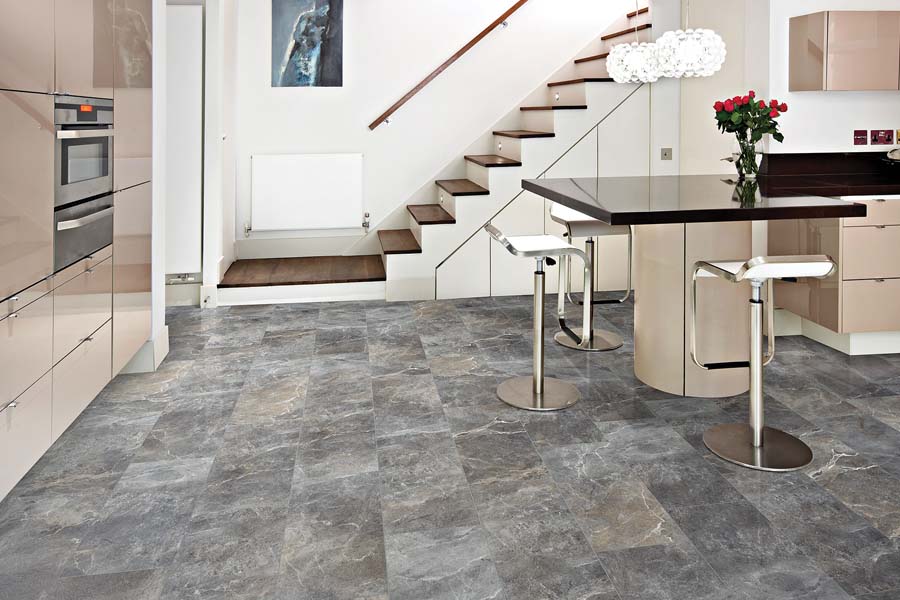
Luxury vinyl tile can do the same for stone and ceramic looks. You might get the visual effect of marble, slate, concrete, or another hard material without exactly replicating how that natural material feels underfoot.
That can be useful when you're designing a space where you love the appearance of a hard surface but want different performance or maintenance characteristics.
Does WPC luxury vinyl feel softer underfoot?
Core construction can have a noticeable effect on luxury vinyl.
WPC, commonly called wood plastic or wood polymer composite, has a rigid waterproof core. WPC products are often valued for providing a slightly more resilient and comfortable feel underfoot than denser rigid-core alternatives.
That can make WPC worth exploring for bedrooms, living rooms, kitchens, and other areas where comfort is high on your priority list.
WPC can also provide good sound-reducing qualities, depending on the complete product construction and installation system.
Still, don't select flooring based on the letters "WPC" alone. Two WPC floors may have different overall thicknesses, wear layers, attached pads, finishes, warranties, and performance ratings.
The complete product matters.
How does SPC luxury vinyl feel underfoot?
SPC, or stone plastic/polymer composite, takes a slightly different approach.
Its core is dense and rigid. This construction gives SPC strong dimensional stability and resistance to indentation. Because the core is harder, SPC may feel firmer underfoot than some WPC products.
For busy homes and commercial spaces, that firmness may be a worthwhile tradeoff for the performance characteristics you're seeking.
Attached underlayment can also change the experience. Some SPC products include a pad designed to improve sound control and provide a more comfortable feel.
So, which is better: WPC or SPC?
There isn't one answer. If maximum underfoot comfort is your priority, you may lean toward certain WPC products. If rigidity and dent resistance rank higher, SPC may deserve closer attention. Compare actual samples whenever possible rather than choosing based only on specifications.
Does flooring thickness affect comfort?
It can, but thicker doesn't automatically mean more comfortable or higher quality.
Luxury vinyl flooring is available in different overall thicknesses. A thicker construction may feel more substantial underfoot, particularly when combined with an appropriate core and attached pad.
But thickness is just one measurement.
A thinner premium product with strong construction may outperform a thicker product in other ways. Wear layer, core density, surface finish, locking system, underlayment, and installation quality all matter.
If you're searching for the best LVP flooring, avoid comparing products based on a single number. Think of flooring as a complete system.
Ask yourself: How will it feel? How will it handle traffic? Is it suitable for the room? What maintenance does it require? What does the warranty cover?
Those questions tell you far more than thickness alone.
Does underlayment make LVP flooring more comfortable?
Underlayment can affect comfort, sound, and the overall feel of the finished floor.
Some luxury vinyl plank flooring comes with an attached pad. Other products may require or permit a separate underlayment. Requirements vary, and not every underlayment is compatible with every luxury vinyl product.
Using an unapproved underlayment can cause problems. It may create too much movement beneath click-lock joints or conflict with manufacturer installation requirements.
That's why more cushioning isn't automatically better.
Follow the flooring manufacturer's specifications. If comfort and sound reduction are priorities, discuss them before choosing your flooring so you can find a compatible product and installation system.
Is LVP flooring comfortable in kitchens?
Kitchens are one of the places where underfoot comfort can matter most.
You may spend significant time standing at the sink, island, stove, or countertop. While luxury vinyl isn't a cushioned floor in the way carpet is, many people appreciate that it can feel less hard underfoot than ceramic or stone tile.
LVP flooring also brings another advantage to kitchens: many products are waterproof. That makes everyday spills easier to deal with, although water should still be cleaned promptly.
Wood-look luxury vinyl can create visual warmth, too. Light oak looks can brighten a kitchen, medium brown planks can make it feel welcoming, and darker shades provide contrast against light cabinetry.
You get the character of a wood-inspired visual with the practical qualities of vinyl.
Is luxury vinyl flooring comfortable in bathrooms?
Bathrooms present a different set of priorities.
Hard surfaces can feel particularly noticeable when you're walking barefoot. Luxury vinyl offers a surface that many homeowners find more comfortable than traditional tile.
Waterproof LVT flooring and LVP flooring can also be suitable for many bathroom installations when the specific product is approved for that use.
Luxury vinyl tile is especially interesting here. It can recreate stone, marble, concrete, or ceramic visuals while offering a different feel underfoot from the materials it resembles.
Keep in mind that waterproof flooring does not make the entire room waterproof. Water can still reach walls, transitions, edges, and the subfloor. Correct installation and prompt cleanup remain important.
Does luxury vinyl flooring feel warm underfoot?
"Warm" can mean two things when discussing flooring.
Visually, wood-look luxury vinyl can absolutely make a room feel warmer. Oak, hickory, walnut, and other wood-inspired visuals introduce natural-looking grain and inviting shades.
Physically, luxury vinyl may also feel less cold underfoot than ceramic or stone in the same environment. However, actual surface temperature depends on room temperature, subfloor conditions, sunlight, insulation, and other factors.
This can make luxury vinyl appealing in bedrooms, bathrooms, kitchens, and living spaces where barefoot comfort matters.
If radiant heating is involved, don't assume compatibility. Check the manufacturer's specifications for approved heating systems, temperature limits, and installation requirements.
Can luxury vinyl help make a room quieter?
Comfort isn't only about what your feet feel. Sound affects how comfortable a room feels, too.
Footsteps on hard surfaces can create noticeable noise, particularly in active households. Certain luxury vinyl products, especially those with attached acoustic backing, may help reduce some impact sound.
Core construction and underlayment also influence acoustics.
That can make LVP flooring worth considering in upstairs rooms, hallways, apartments, home offices, and family spaces where reducing footfall noise is desirable.
For projects where acoustic performance is especially important, compare actual sound ratings rather than relying on broad claims. Building construction and installation methods can significantly affect real-world results.
Is luxury vinyl comfortable for homes with children?
Luxury vinyl can make sense for family spaces because it combines several practical qualities.
First, many products provide a slightly more forgiving surface than ceramic tile or stone. That's useful in rooms where children spend time playing on the floor.
Then there's maintenance. Crumbs, tracked-in dirt, and everyday spills happen. Luxury vinyl is relatively easy to sweep, vacuum, and damp mop using manufacturer-approved cleaning products.
Many collections also offer scratch- and stain-resistant finishes. No flooring is completely damage-proof, but choosing a product rated for your household's traffic can help.
For playrooms and family rooms, consider comfort alongside wear layer, surface finish, waterproof construction, and maintenance requirements.
Is luxury vinyl flooring a good choice for homes with pets?
Pets spend far more time in direct contact with flooring than we do, so surface feel matters.
Luxury vinyl provides a smooth, resilient surface that is easy to clean. Waterproof products can also make dealing with water-bowl spills and occasional accidents simpler.
Traction is worth considering. Highly smooth surfaces may feel slippery to some pets, particularly older dogs. Textured wood-look LVP may provide a different feel, although performance varies by product.
Pet nails can still scratch flooring. Keeping nails trimmed and using mats near entrances can reduce unnecessary wear.
When shopping, ask about scratch resistance, finish, texture, warranty coverage, and waterproof performance rather than assuming every luxury vinyl product is equally pet-friendly.
Does luxury vinyl tile feel like ceramic tile?
Luxury vinyl tile can look remarkably similar to ceramic, porcelain, or natural stone, but it won't feel exactly the same.
That's partly the point.
Luxury vinyl tile uses printed visuals and surface texture to recreate the appearance of hard materials. Yet the vinyl construction can provide more resilience underfoot.
This opens interesting design possibilities. You can create a stone-inspired bathroom, concrete-look kitchen, or marble-style entryway while choosing a floor with different maintenance and comfort characteristics than the material inspiring its design.
For homeowners who love tile visuals but hesitate over the hardness of ceramic or stone, LVT flooring is worth comparing in person.
How do you find the best LVP flooring for comfort?
Start by defining what comfort means to you.
Do you want a floor that feels less hard while standing? Are you concerned about cold surfaces? Is footstep noise the bigger issue? Do you spend most of your time barefoot? Are children or pets frequently on the floor?
Once you know your priorities, compare core construction, overall thickness, attached backing, surface texture, installation method, and acoustic ratings.
Then walk on samples.
Specifications are useful, but flooring is tactile. Standing on WPC, SPC, glue-down luxury vinyl, and products with different attached pads can reveal differences that aren't obvious on paper.
The best LVP flooring isn't necessarily the thickest, softest, or most expensive. It's the product that balances comfort with durability, design, maintenance, room requirements, and budget.
How do you keep luxury vinyl comfortable and looking its best?
Fortunately, everyday care is simple.
Sweep, dust mop, or vacuum regularly to remove grit. Dirt can act as an abrasive beneath shoes and furniture, so removing it helps protect the finish.
Clean spills promptly. For deeper cleaning, use a damp mop and a cleaner approved by the flooring manufacturer.
Avoid abrasive scrubbers, harsh chemicals, steam cleaners, and excessive water unless specifically permitted by the manufacturer.
Place protective pads beneath furniture and use appropriate entrance mats to capture dirt before it travels across the floor.
These aren't complicated steps. That's part of luxury vinyl's appeal.
Find comfortable luxury vinyl flooring in Lafayette, LA
Flooring should work with the way you live, not just the way you decorate. If comfort matters, luxury vinyl gives you plenty to explore.
LVP flooring can bring the visual warmth of hardwood to kitchens, living rooms, bedrooms, and other spaces. Luxury vinyl tile can recreate stone and ceramic looks with a different underfoot feel. WPC, SPC, attached padding, thickness, and installation methods provide even more choices.
Gerami's Floors has served Lafayette since 1920 and remains a family-owned flooring business offering options across a wide range of styles and budgets. Whether you're comparing luxury vinyl plank flooring, luxury vinyl tile, WPC, or SPC, the team can help you sort through the differences.
Visit Gerami's Floors in Lafayette, LA, to see luxury vinyl flooring in person. Compare colors. Feel the textures. Walk on different constructions. Then choose a floor that doesn't just look right in your home—it feels comfortable living on it every day.